


Packaging Material Safety – Essential Requirements and Impact
Over 60 percent of all damage claims in Central European gift shops arise from unsafe or insufficiently protective packaging. For gift shop owners, every presentation and every detail matters: customers expect not only a beautifully wrapped gift but also that products remain safe in transit. By understanding the latest requirements for safe packaging materials, you can prevent risks and elevate the customer experience.
Table of contents
- What do we mean by safe packaging material?
- Main types and properties of packaging materials
- Legal European requirements and current regulations 2026
- Role of producers and retailers in safety
- Risks, liability and common mistakes
- Practical solutions for safe and sustainable packaging
Main conclusions
| Point | Details |
|---|---|
| Safe Packaging Material | It is essential that packaging meets strict safety standards to prevent migration of harmful substances, especially in food contact situations. |
| Legal Requirements | New European regulations coming into force in 2026 require full recyclability and restrictions on harmful substances in packaging. |
| Role of Producers and Retailers | Manufacturers and retailers are responsible for the safety of packaging and must be transparent about materials and recycling options. |
| Preventing Errors | Common mistakes such as inadequate risk assessments can lead to serious health risks and legal consequences for companies. |
What do we mean by safe packaging material?
Safe packaging material is a collective term that encompasses much more than just protecting products. It refers to materials that not only offer physical protection but also meet strict health and environmental safety requirements. Safe packaging must protect products from damage, contamination, and spoilage , without releasing harmful substances.
The definition of safe packaging material has several dimensions. First, the material must meet legal standards that prevent hazardous substances from migrating into products, especially those in contact with food. Various materials such as paper, cardboard, metal, glass, and plastic are used, each with specific properties and safety guidelines. European and Dutch legislation imposes strict requirements: packaging must not leak and must not negatively affect the taste, smell, or color of products.
For retailers and manufacturers, this means that careful selection and testing of packaging materials is crucial. The chain of responsibility requires continuous monitoring and adherence to safety standards , ranging from compliance to strategic innovation in material selection. Manufacturers must demonstrate that their packaging meets all safety requirements before it can be marketed.
Pro tip: Always have the safety certificates of your packaging materials checked and specifically ask the supplier for migration tests.
Main types and properties of packaging materials
Packaging materials are essential for protecting, preserving, and presenting products. There are various types of materials with unique properties and applications , each offering specific advantages for different purposes. The most commonly used materials are paper, plastic, metal, glass, and biodegradable alternatives.

Paper and cardboard are popular choices due to their versatility and environmental friendliness. They are widely used for retail packaging, are lightweight, relatively inexpensive, and easily recycled. Plastic, on the other hand, offers excellent protection and flexibility, especially for products that need to remain moisture- and airtight. Metal packaging, such as tins, is particularly suitable for preservation and long-term storage.
Several factors play a role in the selection of packaging materials. Paper versus plastic packaging each has its own advantages and disadvantages in terms of sustainability, protection, and environmental impact. Glass packaging offers a high-quality appearance and is excellent for products where transparency and reuse are important. Biodegradable materials are gaining popularity as a sustainable alternative, especially in sectors that strive for minimal environmental impact.
Pro tip: Always choose packaging materials that not only suit your product but also align with your sustainability goals and brand identity.
Below you will find an overview of the properties of common packaging materials:
| Material | Main advantage | Typical application | Environmental impact |
|---|---|---|---|
| Paper & cardboard | Easily recyclable | Retail packaging | Low emissions, forest use |
| Plastic | Moisture and airtight | Food, bottles, foil | Slow decomposition, recyclable |
| Metal | Excellent preservation | Cans, beverage containers | Easily recyclable |
| Glass | Transparent & reusable | Juices, cosmetics, delicacies | Heavy, energy-rich production |
| Biodegradable | Compostable waste stream | Food service, organic sector | Limited industrial composting |
Legal European requirements and current regulations 2026
The new European Packaging Regulation marks a crucial step towards more sustainable packaging solutions. This legislation, which comes into effect on August 12, 2026, introduces far-reaching requirements for manufacturers, importers, and retailers throughout the European Union. The focus is explicitly on recyclability, reduction of harmful substances, and minimization of packaging waste.
The new regulations contain concrete measures that will bring about far-reaching changes. Companies must adhere to binding targets for reuse and recycling , with the ultimate goal of full recyclability of all packaging. Key provisions include a ban on packaging with non-separable layers, mandatory use of recycled materials in plastic packaging, and a maximum reduction of empty space in packaging to 50%.
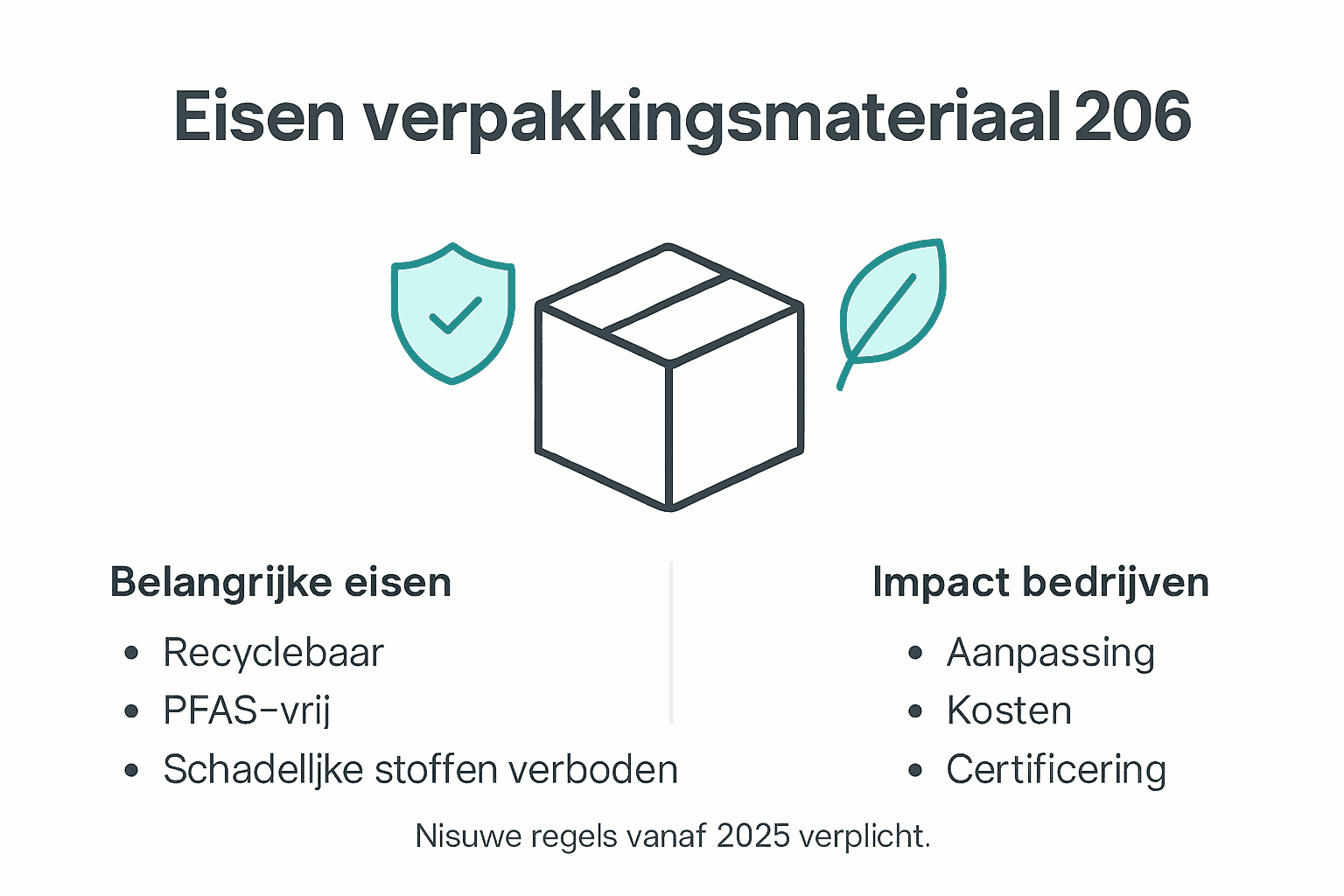
Of particular concern for companies are the strict regulations regarding harmful substances. PFAS are being completely banned from food contact packaging, requiring significant adjustments in material selection and production processes. Manufacturers must revise their entire packaging strategy to comply with these new European standards, focusing primarily on maximum recyclability and minimal environmental impact.
Pro tip: Take inventory of your current packaging materials in a timely manner and start a phased transition to fully recyclable alternatives.
Role of producers and retailers in safety
Manufacturers and retailers bear a fundamental responsibility for ensuring packaging safety and sustainability. They are the first link in the supply chain, responsible for ensuring products meet the strictest safety and environmental standards. Their role includes not only designing safe packaging but also communicating transparently about material use and recycling options.
Each market participant has specific obligations. Manufacturers must develop packaging that is safe for consumers, poses no health risks, and complies with the latest European regulations. Retailers are obligated to offer only products that meet these safety standards , which requires careful monitoring and selection of suppliers.
The law sets clear requirements for traceability and liability. If packaging does not meet safety standards, both manufacturers and retailers can be held accountable. This means they must proactively work on quality control, material innovation, and continuous monitoring of their supply chain. This involves not only legal compliance but also protecting consumers and minimizing environmental impact.
Pro tip: Develop a structured quality management system that continuously assesses the safety and sustainability of your packaging materials.
Risks, liability and common mistakes
Unsafe packaging poses significant risks for both consumers and businesses. The consequences can range from health issues to significant financial and legal ramifications. Manufacturers, importers, and retailers are directly responsible for the safety of their products and can be held liable for damages resulting from defective packaging.
Common mistakes in the packaging industry include inadequate risk assessment, a lack of technical documentation, and insufficient traceability. European product safety legislation imposes increasingly stringent requirements on product safety assessment , which includes not only physical properties but also aspects such as cybersecurity, labeling, and user instructions.
Failure to comply with safety standards can result in serious penalties. Products can be withdrawn from the market, fines can be imposed, and lawsuits can be filed by affected consumers. This emphasizes the importance of a proactive approach where companies continuously evaluate their packaging processes, identify and mitigate risks, and stay up-to-date with the latest regulatory requirements.
Below is a summary of common packaging safety mistakes and their consequences:
| Common mistake | Possible consequence | Proposed solution |
|---|---|---|
| Insufficient risk assessment | Health risks for consumers | Implemented protocol and frequent checks |
| No technical documentation | Legal liability increased | Always keep your file up-to-date |
| Lack of traceability | Difficult recalls in case of incidents | Implement a full tracking system |
| Missed regulation updates | Fines and possible product recalls | Continuously monitor and adapt legislation |
Pro Tip: Develop a detailed risk management protocol that includes regular audits, documentation, and prompt corrective action.
Practical solutions for safe and sustainable packaging
In Central Europe, countries are collaborating to support companies in the transition to sustainable packaging, a promising development for the future of packaging materials. This international collaboration focuses on standardizing packaging processes, encouraging innovative design, and promoting recyclability.
Companies can take practical steps to make their packaging safer and more sustainable. Concrete solutions include choosing recyclable materials that meet regulatory criteria , minimizing packaging, and encouraging reuse. Key strategies include switching to bio-based materials, compostable alternatives, and implementing transparent labeling and reporting systems.
The transition to sustainable packaging requires a holistic approach. In addition to material selection, it's essential to consider the entire packaging lifecycle, from design to waste management. Innovation, supply chain integration, and continuous evaluation are crucial for creating packaging solutions that are both safe for consumers and environmentally friendly.
Pro tip: Conduct a regular sustainability audit on your packaging materials and actively seek out innovative, environmentally friendly alternatives.
Make your packaging safe and sustainable with Kadopapier.net
This article clearly demonstrates that safety and legal compliance are essential when choosing packaging materials. The risk of harmful substances, inadequate protection, and non-recyclable materials jeopardizes not only your reputation but also your customers. Your challenge is to use packaging that complies with the latest European regulations while simultaneously ensuring the sustainability and appearance of your products.
At Kadopapier.net, you'll find a wide range of packaging materials carefully selected for safety, quality, and environmental friendliness. Whether you're busy wrapping gifts or looking for reliable packaging solutions for your retail or industrial operations, our products guarantee responsible packaging. Discover our selection of wrapping paper, gift bags, and biodegradable options that align with your sustainability goals.
Don't wait for new regulations to catch up. Ensure your packaging is safe today through Kadopapier.net and leverage our expertise to future-proof your packaging. Visit our site and choose certainty, sustainability, and style in every package.
Frequently Asked Questions
What is safe packaging material?
Safe packaging materials are materials that meet strict health and environmental safety requirements and protect products from damage, contamination, and spoilage without releasing harmful substances.
What materials are commonly used for packaging?
The most commonly used materials are paper, cardboard, plastic, metal, glass, and biodegradable alternatives. Each type has specific properties and advantages for different applications.
What are the important requirements for packaging materials according to European legislation?
The new European legislation requires, among other things, full recyclability of packaging, a ban on packaging with non-separable layers and the use of recycled material in plastic packaging.
How can companies make their packaging materials safer and more sustainable?
Companies can choose to use recyclable materials, minimize packaging, and utilize bio-based and compostable alternatives, while also implementing transparent labeling and reporting systems.